Packing supplies tend to migrate. Tape moves to the desk, spare labels settle beside the printer and flattened cartons lean against whichever wall is free. That migration is often a reasonable response to an unreasonable storage system. A closed box at the bottom of a stack is not a useful home for something needed every few minutes.
Begin by separating sellable inventory from packaging materials. Both need records, but they answer different questions. Product stock tells you what can be sold. Supply stock tells you whether those sales can be packed properly. A room can be full of products and still stop working because the correct carton has run out.
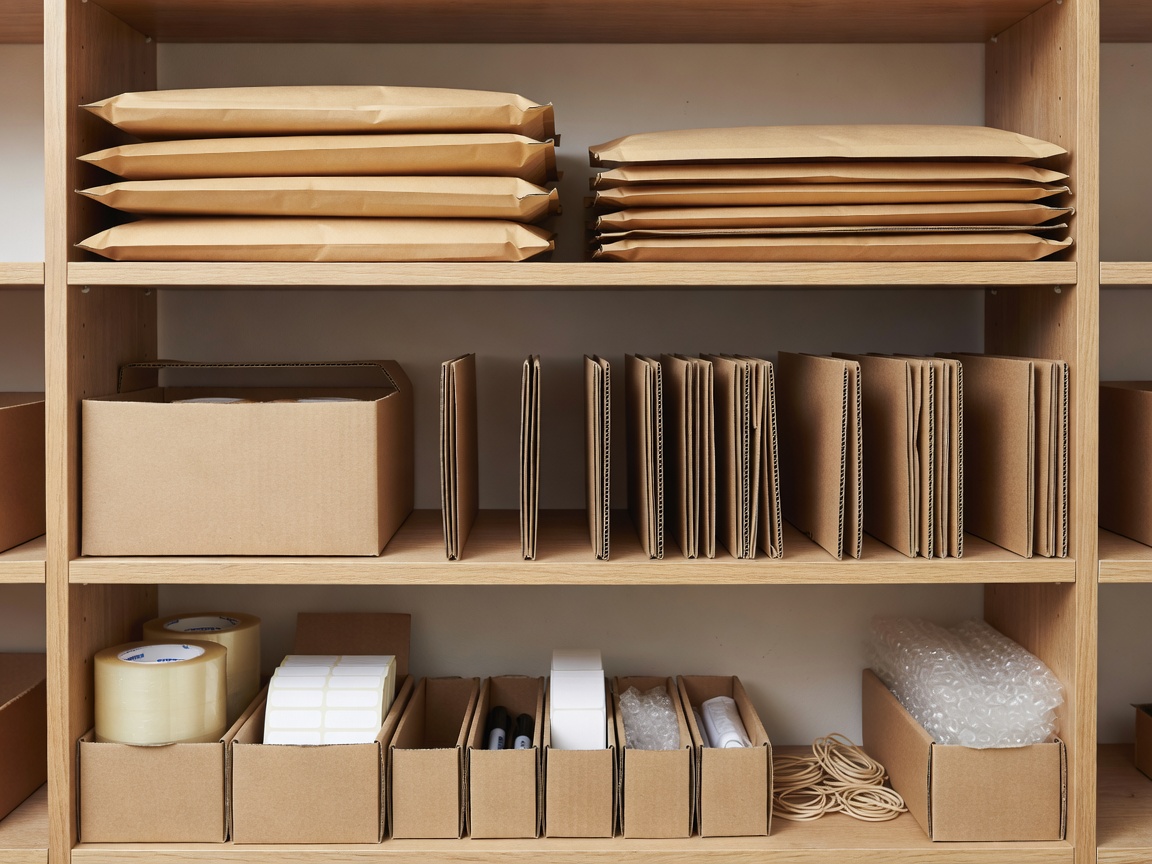
Sort by use before buying containers
Lay out a representative selection of supplies and identify what you use during almost every packing session. Give those items the easiest safe access. Reserve quantities can live farther away, provided replenishment does not require unsafe reaching or dismantling a stack. Slow-moving seasonal materials should not occupy the most convenient shelf simply because they arrived first.
Keep tools distinct from consumables. A tape dispenser has a fixed home; replacement rolls need a count and a reorder cue. The same principle applies to scissors and spare blades, a printer and its labels, or a scale and its batteries. Store sharp tools securely, especially where children or other household members may enter.
Build a shelf map you can read
Use short location codes such as A1, A2 and B1, then attach plain-language descriptions. A code helps your stock record; the description helps a tired person returning supplies after a long evening. If several carton sizes look alike, label their internal dimensions and your own stock reference rather than relying on appearance.
| Location | Contents | Working rule |
|---|---|---|
| A1 | Daily mailers | One labelled bin per size |
| A2 | Tape and paper refills | Open stock in front; reserve behind |
| B1 | Flattened cartons | Upright dividers; dimensions visible |
| C1 | Returns awaiting inspection | Separate from available products |
Do not use shelf position as the only source of identity. A container may be moved during cleaning or restocking. Put the item description on both the shelf and the bin, and keep a simple record connecting product identifiers to their storage locations.
Make replenishment a routine
Choose a working quantity from actual use and available space. There is no universal minimum that suits every home seller. A sensible reorder point considers average consumption, supplier lead time, unusually busy periods and the consequences of running out. Begin with a modest record and revise it as you learn.
A two-bin method can work for small consumables: use the first bin, then reorder when you begin the reserve. The reserve must cover the expected replenishment period; otherwise the second bin only disguises a shortage. For cartons and paper, a marked minimum line or a weekly count may be easier than maintaining duplicate containers.
Store for the room you actually have
Flatten cartons where appropriate and keep them dry, clean and protected from damage. Separate sizes with vertical dividers so that removing one does not collapse the rest. Avoid overfilling high shelves or balancing bulky cartons above the work area. Follow the shelving manufacturer’s load limits and installation instructions, including suitable anchoring where required.
Under-bench storage is useful only while it preserves knee, foot and movement space. Keep heavy or awkward items where they can be handled safely, rather than assuming every low shelf is suitable. Do not use household pipes, electrical equipment or radiators as support points for improvised racks.
Keep stock records proportionate
A small operation may start with a spreadsheet in LibreOffice Calc or Microsoft Excel. Record a unique product reference, location, available quantity and any reserved or quarantined units. Update the record when goods arrive, sell, return or are written off. A periodic physical count catches the mistakes that every system eventually accumulates.
If you use barcodes, understand the difference between your internal identifiers and identifiers required by a marketplace or retail partner. GS1 publishes guidance on its identification standards. A barcode alone does not make an inventory accurate; the receiving and adjustment habits around it do.
Finish with a short reset
At the end of a session, return tools, refill the working supply and remove empty packaging. Check whether any bin repeatedly overflows or remains untouched. Those observations are more useful than arranging everything for a photograph. Storage succeeds when another ordinary order can begin without a search.
The empty-bin test
Take one container off its shelf. Can you still tell what belongs there, which size it is and when to replenish it? If not, improve the label before buying another organiser.
Organise the Label Corner