Start with an ordinary sale rather than an empty-room drawing. The order appears on a screen, the item leaves storage, protective material comes off a shelf and the parcel eventually reaches the door. Every one of those transitions needs a little space. When no space is assigned, the nearest chair, stair or kitchen counter volunteers.
The working triangle is a planning aid, not a measured formula. Its three points are picking, packing and dispatch. In a narrow room they may form a line. At a shared table they may live in portable containers. What matters is that work moves forward without repeatedly crossing its own path.
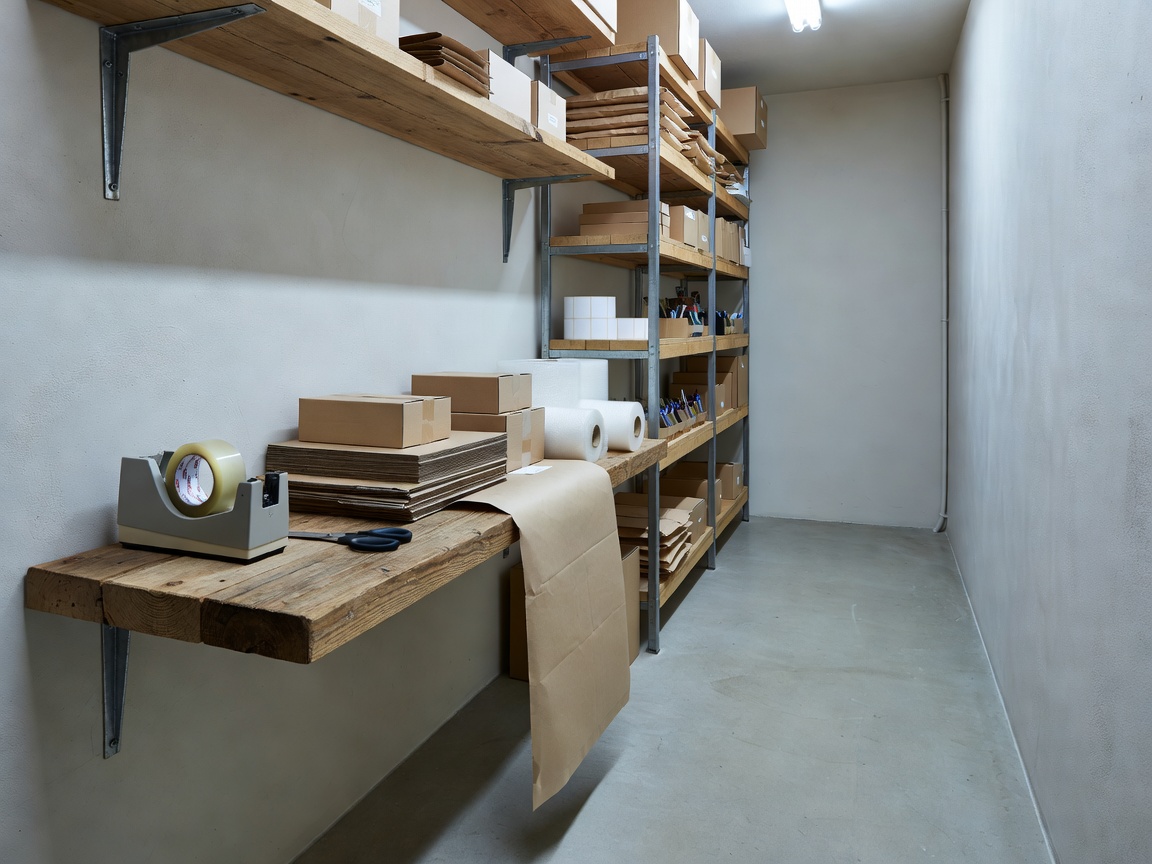
Observe before moving furniture
Pack one representative order and write down every journey. Include the small ones: retrieving scissors, finding an order slip, moving a laundry basket and searching for the correct carton. Record where you put the parcel while checking its address. Those pauses show where the room needs a landing place rather than another storage cabinet.
Next, sketch doors, windows, sockets, radiators and furniture that must remain. Mark door swings and household routes. Do not treat an escape route as overflow storage, even temporarily. If customers, children or pets enter the room, plan a boundary between the work and the shared space.
Choose the smallest useful arrangement
A straight wall bench works well when storage sits beside or above it and outgoing parcels can wait nearby without blocking movement. Keep the active surface clear enough for your typical order, not the smallest item you sell. A large carton needs room to turn and close without catching a lamp or computer cable.
An L-shaped arrangement can separate clean checking work from cutting and wrapping. It is useful only if the corner remains accessible. Deep corner storage often becomes a hiding place for obsolete cartons. A shared dining table needs a different discipline: one supply trolley or tray, one protected packing mat and a defined reset routine after every session.
Layout plate: a sequence, not a scale drawing. Adapt the positions to your room, access needs and safe clearances.
Give waiting work a status
Incoming deliveries, picked orders, returns and completed parcels should not share an unnamed pile. Assign each a tray, shelf section or clearly marked container. An incoming item is not available stock until it has been checked. A return should not go back into the picking location before its condition and records have been reviewed.
For multi-item orders, keep the order together in one container until packing starts. If you process several orders at once, use a reliable identification method and preserve the connection between items and order reference. Fast movement is not useful if it makes a wrong-item dispatch harder to spot.
Keep the doorway out of the workflow
The front door is a destination, not a permanent parcel rack. Choose a short-term outgoing zone that preserves access and does not expose addresses to visitors. Separate collections or carrier services when that distinction prevents mistakes. Check the current handover, tracking and acceptance requirements directly with Royal Mail, USPS, UPS, FedEx or DHL, according to the services you actually use.
Measure the largest parcel route before buying furniture. The bench may fit while the finished carton cannot pass the chair. Consider the movement of a person carrying a load, not only the space occupied by the load at rest.
Test the plan with real work
Use removable labels to trial locations before fixing shelves or purchasing cabinets. Run several normal packing sessions and include an awkward order, a return and a restock. Notice whether supply containers migrate back onto the bench. Migration often means their assigned home is too far away, too crowded or difficult to open.
Keep the improvement modest enough to maintain. A clear work surface, a legible status system and a dependable reset can outperform an elaborate room that requires constant rearranging. Once the route works, refine the storage and equipment around it rather than beginning again with a shopping list.
Your next workshop note
Write a single sentence for each stage: “Incoming goods wait here.” “This surface is for active packing.” “Completed parcels go here.” If two sentences point to the same crowded spot, resolve that conflict first.
Give Supplies a Home