An awkward reach rarely announces itself as a design problem. It appears as a shoulder lifted to reach tape, a wrist bent while closing a carton or a twist towards the outgoing stack. In a short session you may barely notice. As the same movement repeats, the arrangement deserves closer attention.
This guide offers general planning information, not an individual ergonomic assessment or medical advice. Your abilities, health, tasks and equipment matter. If work causes pain, numbness or persistent discomfort, stop and seek appropriate professional advice rather than relying on a furniture adjustment alone.
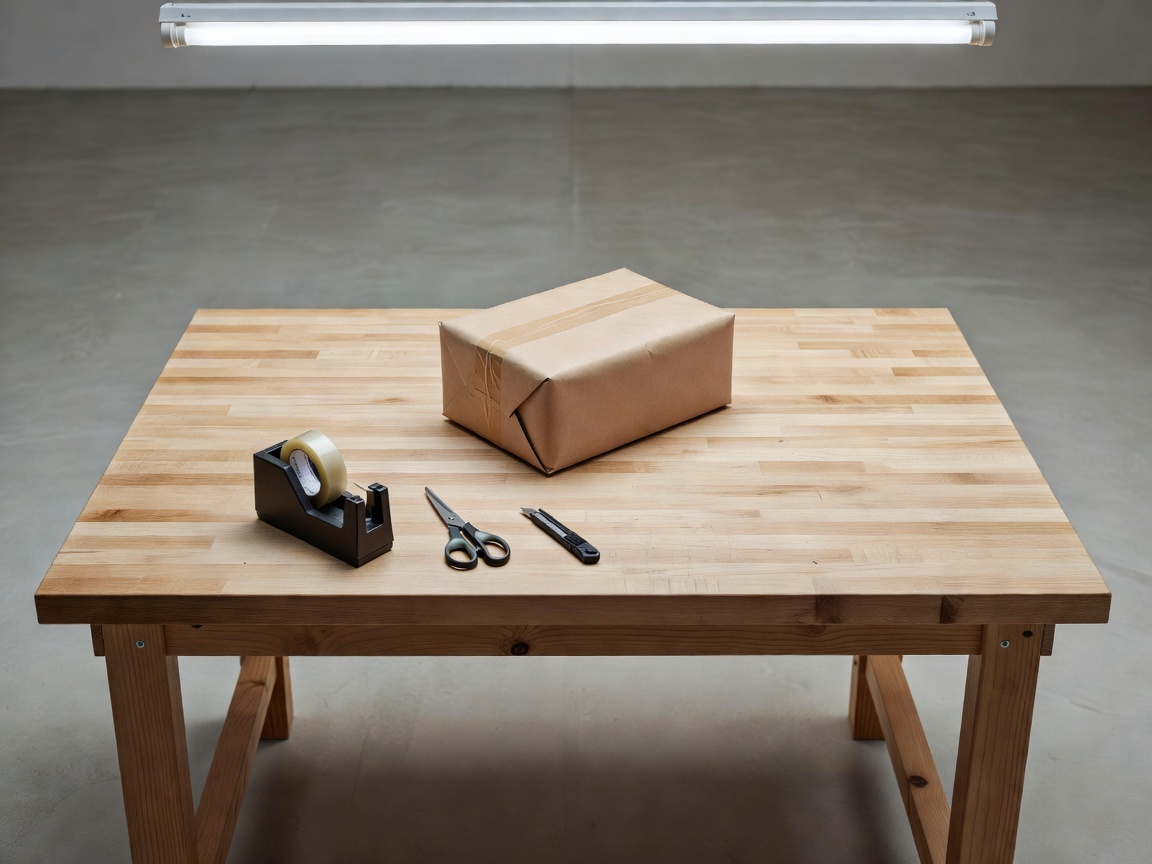
Observe the complete task
Watch a normal packing sequence from picking to handover. Notice not only lifting, but also holding, pushing, pulling, cutting and standing in one position. A lightweight item can still involve an awkward repetitive task. Record the places where you lean on the worktop, raise an elbow, bend repeatedly or shift your feet because storage blocks the approach.
If several people use the station, ask each person to try it. A surface that suits one user may be unsuitable for another. Adjustable equipment can help, but only when it is stable, suitable for the load and easy enough to adjust that people actually use the feature.
Test height with the parcel in place
The useful working height is affected by the object, not just the tabletop. Closing a tall carton raises your hands well above the bare surface. Detailed checking of a small object may create a different need from taping a bulky box. Test representative tasks before settling on a bench.
Aim to work with relaxed shoulders and without sustained bending or unnecessary wrist deviation. Do not treat a single published desk height as a universal packing standard. If you trial a different surface, use a safe, stable arrangement; loose blocks or stacked furniture are not an acceptable substitute for properly designed adjustment.
Give frequent movements the nearest space
Place commonly used tools where you can retrieve and replace them without leaning across the parcel. This will usually be closer than the far edge of a deep worktop. A shallow tool tray can define a home for tape, scissors and a marker while leaving the main surface clear.
Keep reserve supplies out of the immediate movement area. If a paper roll or dispenser is mounted to the bench, follow its installation instructions and check that its position does not force repeated high reaches. Avoid sharp projections, dangling cords and accessories that make it difficult to step close to the work.
Reduce handling before improving technique
Ask whether a lift is necessary. Could goods arrive closer to their storage position? Could the outgoing holding surface be at a more useful level? Could a suitable trolley reduce carrying? A technique reminder cannot make an unsuitable load or obstructed route safe.
There is no single safe lifting weight that applies to every person and situation. Load size, grip, stability, frequency, travel distance and the environment all matter. Follow relevant local guidance and arrange suitable help or equipment for difficult loads. Avoid twisting while carrying; plan the route and make sure there is a clear place to set the parcel down.
Leave space for feet, knees and changes of position
Under-table storage is tempting in a small room, but it can prevent you from approaching the work. Leave appropriate space for the way you sit or stand, including any mobility equipment you use. Store cartons elsewhere if their presence makes you reach forward for every task.
Standing all evening is not automatically better than sitting all evening. Where the task allows, change position and alternate activities. A mat or supportive seat may be useful in a suitable setting, but neither fixes poor height, excessive reach or a trip hazard. Select accessories for the actual floor and work conditions.
Use breaks to interrupt the pattern
Organise work so that the same demanding movement is not the only activity for a prolonged period. Short changes of task can provide variation, provided the alternative does not repeat the same strain. Keep a reset routine that includes clearing the floor and returning tools rather than allowing fatigue to create new obstacles.
For computer work at the label corner, review screen position, input devices and the time spent using them separately from the packing task. HSE display-screen guidance, OSHA workstation information, NIOSH manual-handling resources and CCOHS materials provide useful starting points. Their scope and legal context differ; use guidance appropriate to your location and work.
A practical observation
If a tool is always pulled closer during packing, it is telling you where its working position belongs. Change the storage arrangement instead of asking yourself to tolerate the extra reach.
Revisit Your Packing Layout